
This month was… Interesting. Most of the world was recovering from a global pandemic, while some parts were embracing it. Much of the world was on fire (literally). And in the midst of all that, I found myself studying the biggest mystery of all, one that has always eluded my understanding: Humans.

Specifically, I studied “Usability Engineering”, or “how to make stuff so people can use it”. The principles are simple in application, but interfacing with other humans has always been one of my weakest points. I was unsure how this course would affect this aspect of my personality, or if it would at all, but I believe that I have learned some important methods. Most importantly, we studied user-based research.
In my mind, my capstone project is fairly straight-forward… I need a screen for visually programming drones, I need a screen for observing their combat, and I need menus to connect them and each other. While on the surface this might sound simple, upon pondering this, and the idea that not everyone will be testing the game on a ten-inch tablet, I realized that user involvement is definitely needed. The mechanics of the game might be all mine, but I will need to engage others regarding the interface design.
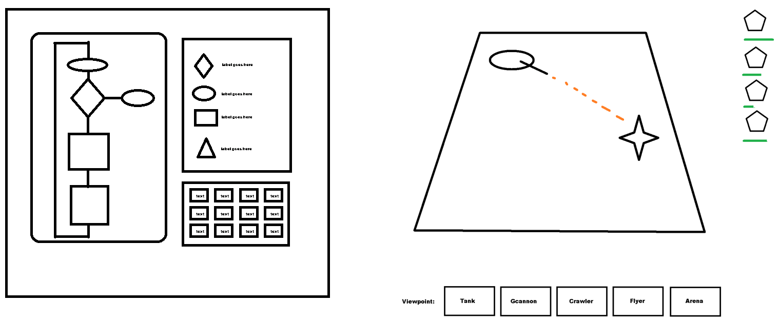
To that end, my plans for user research involve two types of information gathering: Desirability Studies and Participatory Design Workshop. First, I will gather elements of the interface and work with my player group regarding the best layout, control sizes, and other details. Once I have compiled a “paper” prototype for the interface, I will assemble an more dynamic prototype that can actually be observed by the player group.
This will allow me to get user input regarding interface design during the design process, and then again after the design is more settled. If all of this is satisfactory to the player group, I can move forward with actually creating the interface. If not, this will be an excellent time for them to raise their concerns.
Throughout this month’s course, I learned other details, like some information I needed regarding prototyping, and some of the formal “paperwork” that goes with software design in a corporate setting. Even if I find myself working independently, this information will be helpful. I feel as though this course has prepared me for an aspect of software design that has eluded me in the past – the aesthetics. I look forward to seeing how this helps my final product.



 Ashley King's Mastery Journal